
Thinking of Adding an ADU in Massachusetts? What You Need to Know
Accessory Dwelling Units (ADUs), in-law apartments, backyard cottages, and tiny homes are gaining popularity around Massachusetts. A new statewide ADU law has opened up zoning access in many communities, and an increasing number of Massachusetts homeowners are exploring ADUs for multigenerational living, long-term rental income, and greater flexibility on their property. We at Fagone Plumbing, Heating, and HVAC are beginning to see the demand. Homeowners are calling and emailing with questions about mechanical design, heating and cooling options, plumbing layout, radiant heat, and code requirements to build a safe and efficient ADU. We put together this comprehensive, easy-to-read guide to ADUs in Massachusetts based on current legislation, building code practice, state incentives, industry research, and our own experience providing mechanical systems for ADUs throughout the North Shore and Greater Boston.
An ADU Explained
An Accessory Dwelling Unit is a self-contained living space on the same lot as a single-family home. An ADU must operate independently from the main house with its own entrance, kitchen or kitchenette, full bathroom, and sleeping area. ADUs come in a few different configurations: Interior ADUs are existing basements, attics, or reconfigured interior spaces that are code-compliant. Attached ADUs include an addition, such as over a garage apartment or extending from a side of the house. Detached ADUs include backyard cottages, pool-house upgrades, and garage conversions. Homeowners often start their design process with AARP’s Accessory Dwelling Units: A Step-by-Step Guide to Design and Development, which provides practical information on layout options, privacy planning, and project workflow.
Massachusetts Legalized ADUs Statewide
As of February 2, 2025, Massachusetts communities are required by the Affordable Homes Act to allow at least one ADU by right on any single-family residential lot. For more detailed information ADUs, visit the Mass.gov website. This opens up ADU opportunities across the state, making it easier to build and reducing zoning barriers. ADUs are Allowed by Right. A standard building permit is all that is now required for an ADU. All mechanical, plumbing, electrical, and fire safety regulations must be followed.
ADU Size Limits:
ADUs are limited in size by the state to the lesser of:
900 square feet
Fifty percent of the finished floor area of the main house
Finished floor area includes the living room, bedrooms, hallways, basements, and attics, already meeting code. Unfinished attics and unfinished basements, porches, decks, and garages do not count.
Parking Requirements:
Homes within a half mile of public transit cannot be required to provide parking. In other cases, the home may be required to add at most one space.
Short-term rentals:
Local communities may have bylaws around short-term rentals. Homeowners should check with their community if they are planning nightly or weekly rental stays.
Owner Occupancy:
Cities and towns may not require the owner to occupy either the main house or the ADU.
Local Review is Still Required
Although ADUs are now legal statewide, building departments will still perform plan review and construction oversight. Drawings are reviewed for zoning, setbacks, structural soundness, fire separation, and mechanical, electrical, and plumbing requirements. Plan review and approval often take four to eight weeks. Properties on septic systems are subject to a Title 5 review if the ADU creates an additional bedroom or adds a plumbing fixture count. Since septic systems are sized by bedrooms, this should be planned for early in the design stage. Fagone works with homeowners to review fixture count, hot water requirements, drainage layout, and mechanical equipment to try to prevent issues with Title 5 limits. Local variation will impact setbacks, height limits for detached ADUs, trenching depths, frost protection, and utility routing. Learning about these requirements up front helps avoid later roadblocks.
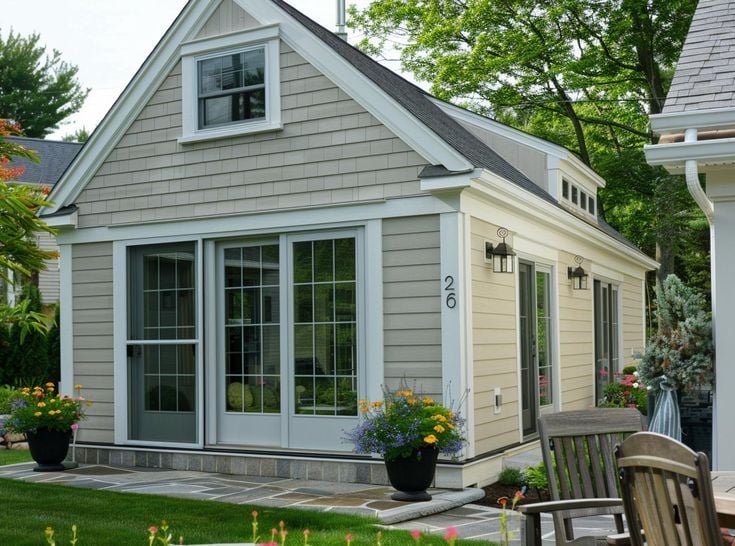
Stand alone garage conversion. Image courtesy of Cozy Nest Creators (cozynestcreators.com) and BuildX (BuildX,com)
Common and Creative Uses for ADUs
ADUs provide housing flexibility to serve a wide variety of needs and life stages. Many homeowners are building ADUs to provide in-law suites or private living space for adult children. Another common use is to house long-term guests or to provide a separate transitional living space during life changes.
ADUs can be used for private caregiver housing, such as:
Live-in caregivers
Home health aides
Nannies or au pairs, Industry analysis shows
ADUs are often more cost-effective than purchasing a second rental property. 4 Reasons to Build an ADU Instead of Buying a Rental Property (Hiatus Homes, 2024) found that ADUs often have a higher rate of return because the homeowner already owns the land and can build an energy-efficient unit that is better for long-term renters. Research into compact living solutions, such as the PDF document Understanding the Spatial Distribution of Tiny House Villages for the Homeless, shows how small, well-built spaces can address many different housing needs in communities across the country.
ADU and Small Home Trends
Interest in compact and energy-efficient living continues to rise across the United States. National construction data shows that the average ADU in the United States costs about $180,000, while Massachusetts projects often fall between $250,000 and $450,000. Local energy code requirements, excavation needs, and skilled labor costs all contribute to the higher price range in the Commonwealth.
Homeowners consistently prioritize privacy, long-term flexibility, and easy utility access when planning an ADU. These priorities closely align with what we encounter during mechanical design, since heating and cooling choices, plumbing layout, and hot water equipment often influence the overall floor plan and long-term performance of the unit.
Market research and appraiser feedback from across the country suggest that ADUs commonly appraise close to or above their construction cost. We are seeing similar trends in many Massachusetts communities, especially when the ADU is well designed and equipped with efficient mechanical systems.
Planning an ADU in Massachusetts
Homeowners looking to add an ADU should:
Review local zoning and building requirements
Work with a qualified designer or architect
Understand fire separation, egress, ventilation, electrical, and Title 5 requirements
Create a realistic construction budget
Explore Mass Save incentives for heat pumps and heat pump water heaters Mass Save heat pump rebates
Design and Construction Details
An ADU must be well built to meet building code standards for insulation, air sealing, ventilation, and utility planning. Site planning starts with identifying the best routes for underground water, sewer, electrical conduit, and refrigerant lines. Fagone can help homeowners understand trenching needs, frost protection, and utility access. The Massachusetts energy code is a major driver of heating and cooling system sizing. Ventilation and envelope design impact long-term operating costs and comfort. Basement ADUs may need moisture mitigation and sewage ejector pumps. Over-garage ADUs often benefit from radiant heat to counter cold floor conditions. Detached ADUs may have deeper trenching and frost depth installation requirements.
ADU Budget Breakdown
ADU budgets include site work, excavation, framing, roof, insulation, windows, plumbing, HVAC, electrical, interior finishes, fixtures, cabinetry, appliances, engineering, permitting, and inspections. Mechanical system costs are often a large part of the budget because these systems determine comfort, efficiency, and long-term utility costs. Fagone works with homeowners to design mechanical systems that fit their performance needs and budget.
Financing and ROI
ADUs can be financed with home equity lines of credit, construction or renovation loans, cash-out refinancing, or financing programs through Fagone Plumbing, Heating and HVAC. Our financing partners offer low monthly payments and promotional financing to help homeowners afford mechanical system upgrades for ADUs. Learn more: Fagone Financing Options. Massachusetts homeowners may also be eligible for the Mass Save HEAT Loan, which provides 0% financing up to $50,000 for qualifying high-efficiency equipment, such as heat pumps and heat pump water heaters. Research shows ADUs frequently add property value and rental opportunity when equipped with modern heating, cooling, and plumbing.
Fagone Heating, Cooling, and Plumbing Services for ADUs in Massachusetts
Mechanical systems are among the most critical considerations for the comfort, safety, and long-term performance of any ADU. These spaces tend to be small, highly insulated, and often located in awkward places, such as over garages, below basements, or as detached backyard cottages. Proper mechanical planning is essential. At Fagone Plumbing, Heating, and HVAC, we design and install heating, cooling, plumbing, and hot water systems that are up to code and easy to use.
Cold-climate mini-split heat pumps are the most common ADU heating and cooling solution. They offer a highly efficient, compact, and zoned comfort solution. These systems run quietly, deliver year-round comfort, and qualify for generous incentives in Massachusetts. At Fagone, we perform careful heat load calculations based on the ADU's size, window area, insulation levels, and building orientation. Proper sizing is essential to prevent short cycling, uneven temperatures, and wasted energy. Equipment sizing is a common problem with compact living spaces if the loads are not carefully calculated.
Radiant heat is also an excellent option for ADUs located over unconditioned spaces or where floor comfort is a primary concern. Hydronic radiant floors offer consistent, even heating across larger living areas. They are a popular choice for garage conversions or detached cottages. Fagone can help homeowners understand the required insulation levels, control options, and compatibility with different flooring materials.
Plumbing layouts can also be more complex in ADUs, as fixture locations, elevation changes, and access paths are often more limited. Fagone can install complete plumbing systems, including drainage and venting, water supply lines, laundry hookups, fixture connections, and freeze protection as needed. Basement ADUs may require sewage ejector pumps to lift wastewater up to the main sewer line. Detached ADUs typically require trenching for water, sewer, and gas lines at the appropriate frost depth. Careful planning is essential to avoid future blockages, freeze issues, and permit delays.
Hot water equipment can be sized and selected based on the ADU size, occupancy, and expected daily usage. Tankless water heaters are a popular choice as they have a small footprint and can provide continuous hot water for guests or renters. Traditional tank-style water heaters remain a reliable, cost-effective option if the ADU has a dedicated mechanical space. Combi boilers are an efficient two-in-one solution that provides domestic hot water and space heating for ADUs with hydronic radiant heat.
Common ADU-specific hot water solutions include:
Tankless systems are used when mechanical space is limited or usage varies
Tank-style heaters are a good choice when cost and simplicity are priorities
Combi boilers for ADUs using hydronic radiant floors or requiring dual-purpose equipment
Fagone is there for homeowners every step of the way through the mechanical design and construction process. We prepare permit documentation, coordinate required inspections, and verify that all heating, cooling, plumbing, gas, and safety installations meet the Massachusetts code. We work closely with building departments, designers, and homeowners to create ADU mechanical systems that are efficient, reliable, and customized to the space.
Closing Thoughts on ADUs: Value, Comfort, and Long-Term Planning
ADUs offer new possibilities for multigenerational living, rental income, home office expansion, and long-term housing planning for Massachusetts homeowners. With statewide legalization and strong demand for flexible living solutions, a well-designed ADU can add comfort, convenience, and lasting value to your property. Fagone Plumbing, Heating, and HVAC is here to support your ADU project every step of the way. From heating and cooling design to radiant heat, plumbing, hot water equipment, permitting, and inspections, our team has the expertise you need to safely and efficiently bring your ADU to life.
All interior images in this article are courtesy of Cozy Nest Creators (cozynestcreators.com) & BuildX (BuildX.com). Used with permission.